Right Now, an AI Is Describing Your Brand to a Potential Customer. Do You Know What It's Saying?
South African financial services brands are being ranked, recommended, and ignored by AI search engines. Most have no idea it's happening.

NUDG3
AI Search Intelligence Platform
76,652
AI Responses Tracked
Responses analysed across seven AI engines over eight consecutive days
7.8M
SA ChatGPT Users
Estimated South Africans engaging with ChatGPT, 15.3% of internet users
~25%
Platform Source Overlap
Each AI engine draws from a meaningfully different information universe
Based on NUDG3 primary research tracking 92 brands across 7 AI engines, March 2026
Download the Full Report
Get the complete 14-page analysis with brand-by-brand rankings, provider comparison data, and strategic recommendations.
No spam. We'll only use your email to send relevant research.
In this article
The Conversation You're Not Part Of
There's a conversation happening about your brand right now. Not on Twitter. Not in a focus group. Not in a boardroom.
It's happening inside ChatGPT. Inside Perplexity. Inside Google's AI Overviews. Inside Copilot, Gemini, and Grok.
A South African consumer just typed: "What's the best medical aid for a young family in Johannesburg?" or "Which bank has the lowest fees for a small business?" or "Should I invest through Allan Gray or EasyEquities?"
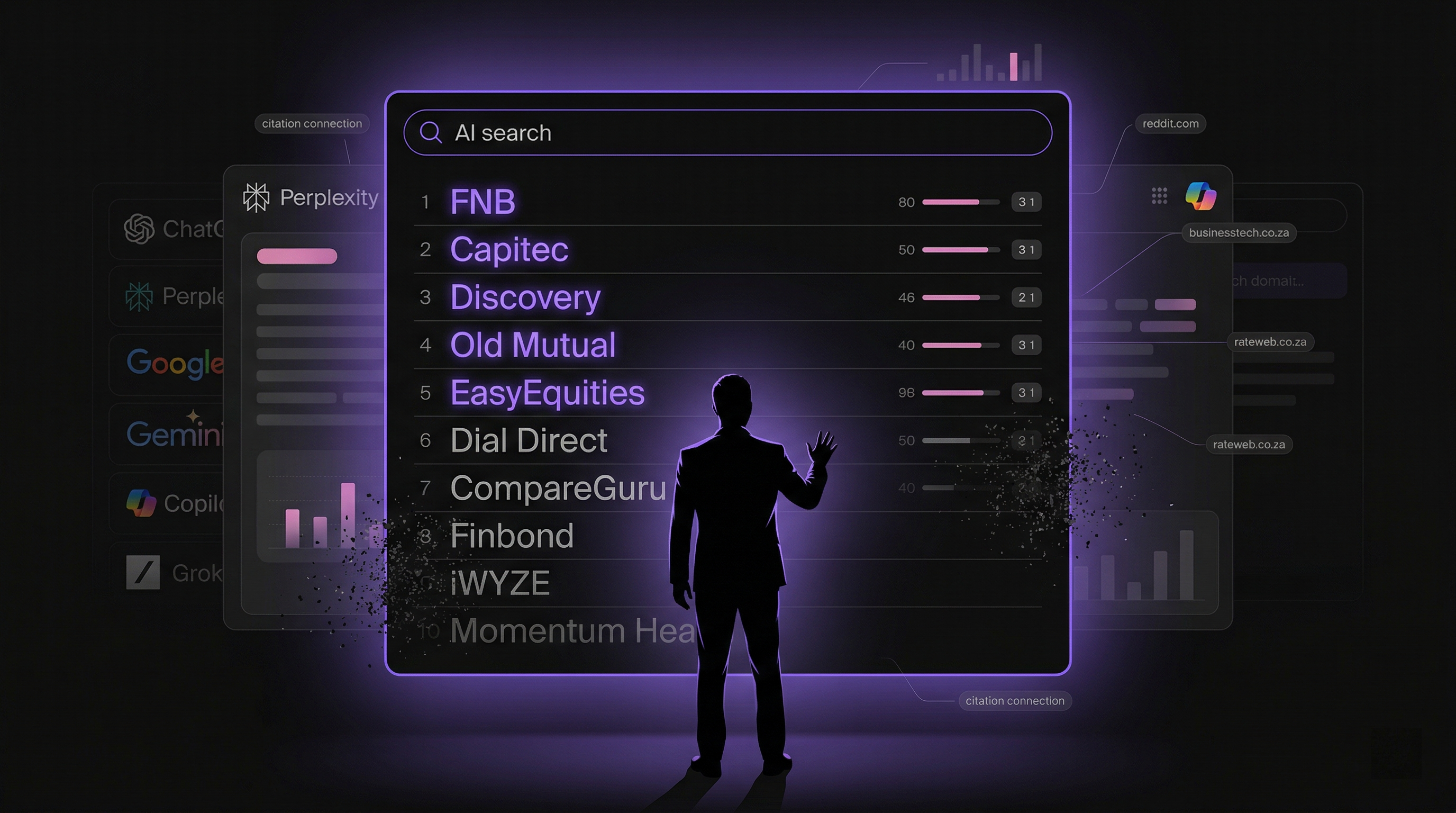
Before seeing any blue links, Google AI Overviews (an AI powered engine) responded. It named brands. It ranked them. It described their strengths and weaknesses. It recommended some and left others out entirely.
The question is: was your brand in that answer? And if it was, what did the AI say about you?
Most South African financial services brands cannot answer that question. They should be losing sleep over it.
This Is Not a Future Problem. It Is a Right-Now Problem.
The instinct is to file AI search under "emerging trends", something for the innovation team to monitor, or maybe revisit in 2027. That instinct is dangerously wrong.
ChatGPT now has over 900 million weekly active users globally, processing 2.5 billion daily prompts, more than doubling its user base in a single year.¹ Perplexity AI grew its monthly query volume by 239% in under a year, reaching 780 million monthly queries.¹ Google AI Overviews now appear in approximately 48% of all tracked search queries,² meaning that for every second Google search, an AI-generated answer sits above the traditional blue links.
These are not projections. These are current numbers.
And they convert. Brands cited in Google AI Overviews earn 35% more organic clicks and 91% more paid clicks than brands that don't appear, based on Seer Interactive's analysis of 25.1 million impressions across 42 organisations.⁴ Adobe reported a 693% surge in AI referral traffic during the 2025 holiday season, with AI influencing over $14 billion in Black Friday online sales.³
Being recommended by an AI engine is not a vanity metric. It is a measurable commercial advantage.
“Being recommended by an AI engine is not a vanity metric. It is a measurable commercial advantage.”
7.8 Million South Africans Are Already Asking AI About Financial Products
If you're thinking "that's a US phenomenon"... it isn't.
South Africa leads African AI adoption, with a reported 15.3% of internet users engaging with ChatGPT, translating to approximately 7.8 million people.⁵ A Fast Company SA survey (October 2025) found 90% of respondents actively use AI technologies, with ChatGPT at 88% usage, Meta AI at 79%, and Gemini at 51%.⁵ Across Sub-Saharan Africa, ChatGPT adoption rose to 28% in 2025, up from 16% in 2023.⁵
These are not early adopters tinkering in a sandbox. These are consumers making real decisions and financial services is one of the categories they're asking about most. J.D. Power found that 13% of consumers use AI for banking queries daily and 59% use it at least occasionally, with top queries including savings strategies (45%), credit cards (41%), and investing and budgeting (36%).⁶ EY's NextWave Research found 68% of consumers are open to AI-driven financial planning guidance.⁶
Meanwhile, Bank of America Global Research warned in March 2026 that $15 billion in global insurance agent and broker commissions are at risk from AI-driven disintermediation, with 10-20% of current business potentially facing disruption.⁶ When Insurify and Tuio launched ChatGPT-powered insurance comparison tools in February 2026, insurance stocks dropped 9% in a single day.⁶
AI is not replacing financial advisors tomorrow. But it is absolutely shaping which brands consumers consider before they ever speak to one.
Your Website Controls Less Than 10% of What AI Says About You
Here is the finding that should change how every CMO thinks about brand strategy:
McKinsey's AI Discovery Survey (August 2025) found that a brand's own website accounts for only 5-10% of the sources AI platforms reference when describing that brand.⁷ The other 90% comes from publishers, news coverage, user-generated content, affiliate sites, and review platforms.
Read that again. Ninety percent of your AI brand narrative is being written by other people.
Edelman's research goes further: up to 90% of the citations driving brand visibility in LLMs come from earned media - not paid, not owned.⁸ In financial services specifically, Fintel Connect found that more than 60% of citations in AI product recommendations came from publishers or affiliate sites, not from the financial institutions themselves.⁹
This means the R10 million you spent redesigning your website, the content hub you built, the SEO strategy you've refined for a decade all influence less than a tenth of how AI engines represent your brand.
What actually drives your AI visibility? Media coverage. Third-party reviews. Industry analysis. Reddit threads. News articles. Conference mentions. The content ecosystem you don't control.
Reddit appears in the top 10 most-cited sources across two-thirds (8 of 12) of the prompt categories we tracked, confirming social proof is a near-universal AI input. Let that sink in.
“Ninety percent of your AI brand narrative is being written by other people.”
— McKinsey AI Discovery Survey, 2025
And Then There's the Language Problem
South Africa has 12 official languages. IsiZulu is the most widely spoken home language at 24.4% of the population. IsiXhosa follows at 16.3%. Sesotho at 7.8%. English, the language of virtually all AI training data and digital financial content, sits at 8.7%.¹⁰
So what happens when a consumer asks ChatGPT a financial question in isiZulu?
The answer, based on published research, is: nothing good.
Mabokela et al. (presented at SAICSIT 2025) found that GPT-4 achieves only 52-55% accuracy on isiZulu and isiXhosa tasks, compared to roughly 80% for specialised models fine-tuned on those languages - a performance gap of more than 25 percentage points.¹¹ The Sahara benchmark study, presented at ACL 2025 by Adebara et al., found "critical gaps in task performance and language coverage" for African languages, driven by what the researchers called "policy-induced data inequities."¹² Adelani et al.'s AfroBench (ACL Findings 2025) confirmed the performance gap between English and African languages across both commercial and open-source AI systems, covering 15 tasks across 64 African languages.¹³
Lelapa AI's InkubaLM project - one of the few models trained specifically on African languages - highlights the scale of the problem: despite 14 million isiZulu first-language speakers and 8 million isiXhosa speakers, both languages remain severely underrepresented in mainstream AI systems.¹⁴
This creates a compounding exclusion. The majority of South Africans speak an African language at home. The AI tools they're increasingly using perform poorly in those languages. The financial brands serving them may not appear at all, or may be described inaccurately, in the AI responses those consumers receive.
For brands like Capitec, which serves 25 million clients (more than half of SA's adult population) and holds a 58% market share among 16-35 year olds,¹⁵ this is not a niche concern. It is a structural blind spot that affects their largest customer base.
The Consistency Problem: AI Doesn't Give the Same Answer Twice
Even if your brand does appear in AI search results, don't assume it will appear next time.
Our analysis, conducted over eight consecutive days and tracking 76,652 AI responses, confirms that AI search results are fundamentally probabilistic: the answer changes every time. While some brands beat the odds, our data shows top performers still only appeared in the majority of responses for relevant queries, and for most brands, visibility drops off dramatically from one AI answer to the next.
This is fundamentally different from traditional search, where a page-one ranking is relatively stable. In AI search, visibility is probabilistic. Your brand might appear in three out of ten answers. Your competitor might appear in seven. Neither of you would know without systematic measurement.
The academic research explains why. Carnegie Mellon researchers (Lin et al., CHI 2025) demonstrated that minor changes in prompt wording can cause up to a 100% difference in which brands get mentioned.¹⁶ A study by Zafeiroudi et al. (February 2025) showed that cognitive biases embedded in product descriptions, such as social proof and scarcity framing, can shift a brand's recommendation position by 50%.¹⁷
AI search is not a leaderboard. It is a slot machine with weighted odds. And most South African financial brands have no idea what their odds are.
“AI search is not a leaderboard. It is a slot machine with weighted odds. And most South African financial brands have no idea what their odds are.”
— NUDG3 Research
The Two-Pot Effect: A Case Study in AI Visibility Inflation
When the two-pot retirement system launched on 1 September 2024, it triggered enormous consumer interest. Over 4 million withdrawal transactions were processed in the first year, totalling roughly R57 billion. SARS handled more than 2.6 million applications. Complaints to the Pension Funds Adjudicator rose by 13%.¹⁸
Every investment and retirement brand in South Africa responded with educational content - calculators, explainers, guides, webinars. Old Mutual, Sanlam, Momentum, Allan Gray, Investec - all of them flooded the internet with two-pot material.
That content didn't just serve consumers. It fed AI training datasets and retrieval indices. The brands that produced the most, the fastest, and on the most widely-cited platforms likely saw their AI visibility spike - not because their products improved, but because their content footprint expanded at exactly the right moment.
This is the new competitive dynamic. AI visibility is not a static reflection of brand strength. It is shaped by content velocity, media coverage patterns, and the timing of major market events. Brands that understand this can engineer their visibility. Brands that don't are leaving it to chance.
What LLMs "Think" About Local Brands vs. Global Brands
There is a structural bias baked into the way large language models represent brands which works against South African companies.
Kamruzzaman, Nguyen, and Kim's landmark paper "Global is Good, Local is Bad?" (EMNLP 2024) - the first systematic study of brand bias in LLMs - found that AI models disproportionately associate global brands with positive attributes and local brands with negative ones.¹⁹ The models recommended luxury brands for high-income countries 88-100% of the time, and non-luxury brands for low-income countries 84-98% of the time.¹⁹
This is not a deliberate design choice. It is a reflection of training data. Global brands generate more English-language content, receive more international media coverage, and appear in more of the datasets that LLMs are trained on. Local brands, even dominant local brands, are underrepresented in the parametric knowledge that AI systems draw on.
For South African financial services, this means a brand that serves 25 million customers in Mzansi may be less "known" to an AI engine than a brand that serves 2 million customers in London. Not because the AI is biased in any intentional sense, but because the information ecosystem is.
The Retrieval vs. Knowledge Divide
Not all AI engines work the same way, and this matters enormously for brand visibility.
Some systems, like Perplexity, are "retrieval-dependent." They search the live web for every query and construct answers from what they find. ByteByteGo's technical analysis of Perplexity's architecture revealed a strict design principle: the system is built so that it does not say anything that wasn't retrieved from an external source.²⁰ Others like ChatGPT are "knowledge-dependent," drawing primarily from patterns learned during training, supplemented by occasional web retrieval.
The Columbia Journalism Review's Tow Center tested eight AI search engines with 200 queries and found that AI engines failed to produce accurate citations over 60% of the time. Perplexity delivered the best accuracy, while knowledge-dependent systems hallucinated at dramatically higher rates.²¹ The Vectara Hallucination Leaderboard confirms that retrieval-augmented generation is the most effective technique for reducing AI hallucinations, cutting them by up to 71%.²²
For brands, this creates a strategic split. On retrieval-dependent platforms, your visibility depends on whether your content (or content about you) is findable and well-structured on the live web. On knowledge-dependent platforms, your visibility depends on whether you were prominent enough in the training data, which may be months or years old.
Our study found that source overlap between AI platforms is modest, at only about 25%. Each platform draws from a meaningfully different information universe.
Your AI visibility strategy cannot be one-size-fits-all. It depends on which AI engines your customers use and how those engines work.
So What Should SA Financial Services Brands Do?
This piece is not a strategy guide. It is a provocation. But there are questions every CMO and brand strategist in South African financial services should be asking right now:
Do you know which AI engines mention your brand and which don't? Not anecdotally. Not from one ChatGPT query you tried in a meeting. Systematically, across platforms, across query types, across languages.
Do you know what AI says about you versus your competitors? When a consumer asks "Which bank is best for a first-time homeowner in South Africa?", does your brand appear? In what position? With what sentiment? And who appears instead of you?
Do you know what happens when consumers ask in isiZulu? In isiXhosa? If your customer base speaks these languages, and the AI tools they use perform 25 percentage points worse in those languages, your brand's AI presence may have a demographic blind spot that mirrors and deepens existing financial exclusion.
Is your earned media strategy designed for AI, or just for humans? If 90% of what AI says about you comes from third-party sources, your PR, media relations, and industry commentary strategy is now an AI visibility strategy, whether you designed it that way or not.
Are you measuring any of this? Traditional brand tracking measures awareness, consideration, and preference among humans. AI search introduces a new layer: what do the machines recommend? This is measurable. But almost no South African brand is measuring it yet.
The Window Is Open. It Won't Be for Long.
The GEO (Generative Engine Optimisation) market is already valued at roughly $850 million to $1 billion, with projections reaching $7-34 billion by the early 2030s.⁸ More than 750 organisations, including many Fortune 500 companies, actively monitor their AI search presence daily.² Over two-thirds of global marketers are already adjusting their strategies for AI search.⁸
South Africa's financial services sector has not yet started this conversation in earnest. That is both a risk and an opportunity. The brands that move first to understand how AI engines represent them, that build content strategies designed for retrieval and parametric knowledge, that address the language gap head-on, will have a compounding advantage that late movers will struggle to close.
Because in AI search, unlike traditional search, there is no page two. There is only the answer. And your brand is either in it, or it isn't.
“In AI search, unlike traditional search, there is no page two. There is only the answer. And your brand is either in it, or it isn't.”
References
1. OpenAI usage data (February 2026); Perplexity AI growth figures (May 2025). As reported by multiple industry sources.
2. BrightEdge, "AI Overview Tracking Report," February 2026. BrightEdge serves 57% of the Fortune 500 and reports 750+ organisations use its AI monitoring tools daily.
3. Adobe, "Holiday Shopping 2025 Report" (December 2025).
4. Seer Interactive, "AIO Impact Study," September 2025. Based on 3,119 search terms, 42 client organisations, and 25.1 million organic impressions.
5. DataReportal, "Digital 2025: South Africa" (January 2025); Fast Company SA, AI adoption survey (October 2025); Sub-Saharan Africa ChatGPT adoption data (2025).
6. J.D. Power, "AI in Banking Consumer Survey," September 2025; EY NextWave Research (2025); Bank of America Global Research, insurance disintermediation analysis (March 2026).
7. McKinsey & Company, "AI Discovery Survey," August 2025.
8. Edelman, "Earned Media and AI Visibility Research" (2025); GEO market sizing from Valuates Reports and Dimension Market Research (2025).
9. Fintel Connect, "AI Citations in Financial Product Recommendations" (2025).
10. Statistics South Africa, Census 2022.
11. Mabokela, K.R. et al., "Sentiment Analysis for isiZulu and isiXhosa Using Fine-Tuned Afro-XLMR," presented at SAICSIT 2025.
12. Adebara, I. et al., "Sahara: A Benchmark for African Language AI Performance," ACL 2025.
13. Adelani, D.I. et al., "AfroBench: 15 Tasks Across 64 African Languages," ACL Findings 2025.
14. Lelapa AI, "InkubaLM: Language Model for African Languages," August 2024. Trained on 1.9 billion tokens across five African languages.
15. Capitec Bank, FY2025 and H1 FY2026 results announcements; market capitalisation data as of April-August 2025.
16. Lin, J. et al., "Prompt Manipulation and Brand Mention Probability in LLMs," CHI 2025, Carnegie Mellon University.
17. Zafeiroudi, M. et al., "Cognitive Biases in Product Descriptions and LLM Recommendations," February 2025.
18. National Treasury, SARS, and Pension Funds Adjudicator data (2024-2025); Investec macroeconomic projections.
19. Kamruzzaman, M., Nguyen, T., and Kim, J., "Global is Good, Local is Bad? Understanding Brand Bias in LLMs," EMNLP 2024.
20. ByteByteGo, "Technical Analysis of Perplexity's RAG Pipeline" (2025).
21. Jazwinska, K. and Chandrasekar, A., "AI Search Engine Accuracy Study," Tow Center for Digital Journalism, Columbia Journalism Review, March 2025. Tested 8 AI search engines with 200 queries.
22. Vectara, "Hallucination Leaderboard" (2025).
Frequently Asked Questions
Download the Full Report
Get the complete 14-page analysis with brand-by-brand rankings, provider comparison data, and strategic recommendations.
No spam. We'll only use your email to send relevant research.
Book a Demo
Monitor your brand visibility across 11 AI engines. Get actionable insights to improve how AI recommends you.